Four terms, one field
Since ChatGPT, Claude, Gemini and Perplexity answer questions directly, a new visibility question exists: is my site mentioned in those answers? And as with every new discipline, the terms appeared faster than the practice. You will run into four of them constantly:
- GEO (generative engine optimization) is the umbrella term. Goal: being cited as a source in generated answers. Instead of a ranking position there is a binary state: mentioned or not.
- AEO (answer engine optimization) emphasizes format. Building content so that a concrete question is answered in two or three sentences and can be extracted cleanly. Featured snippets were the precursor.
- LLMO (large language model optimization) emphasizes the technology: how a language model reads a text, which structure it understands reliably, which entities it recognizes.
- AI SEO is the umbrella term for client conversations. Imprecise, but everyone knows what is meant.
Our advice: work with "GEO" internally. The term is the most widespread, precise enough and self-explanatory. What sits behind it is ninety percent the same anyway, whichever acronym is on the slide.
What the providers actually do
Before any model can cite your page, a crawler must have read it. The providers now document their crawlers properly, and the differences matter:
- OpenAI separates three purposes:
GPTBotfor training data,OAI-SearchBotfor ChatGPT search andChatGPT-Userfor live fetches inside the chat. Since the German launch of ChatGPT Ads,OAI-AdsBotfor landing page checks has joined them. Whoever blocks only GPTBot stays visible in search; whoever blocks everything disappears everywhere. - Anthropic follows the same pattern with
ClaudeBot(training),Claude-SearchBotandClaude-User, all documented, all respecting robots.txt. - Perplexity caused a stir in 2025: Cloudflare demonstrated that Perplexity used undeclared crawlers alongside the declared
PerplexityBotthat circumvented robots.txt blocks. That is the background to why many bot protection systems have been treating AI crawlers more harshly ever since. - Google uses the
Google-Extendedtoken for its AI products. Important, because a stubborn myth circulates here: blocking it has no influence on rankings in Google Search. It only decides whether your content is used in Gemini products. The search Googlebot is unaffected.
The practical consequence: decide per bot, not wholesale. Blocking training crawlers while allowing search crawlers is a legitimate setup. Blocking everything because an old SEO recipe said "allow only Googlebot" costs visibility without protecting anything.
What Google itself says
For Google's own AI answers, the situation has been officially settled since this summer, and soberingly so for anyone selling GEO as a new secret science. On August 20, 2026, John Mueller answered on Bluesky that there is nothing special you can do to appear in Google's AI answers. His colleague Brendon Kraham had put it similarly in June: good SEO equals good GEO, nobody needs to optimize content for bots or pivot to generic top-10 lists. And in May 2026 Google published its first own recommendations for AI search, with the core message that the AI features are built on the same ranking and quality systems as classic search.
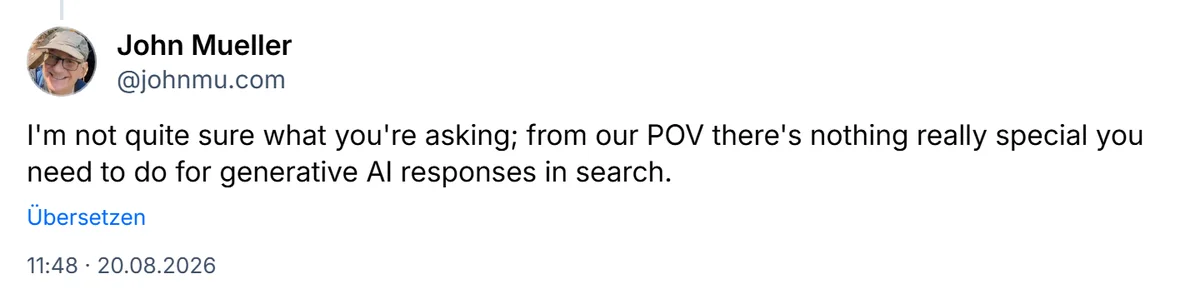
That is one half of the truth. It applies to AI Overviews and AI Mode, meaning answers fed from Google's index. The other half Mueller did not answer: ChatGPT, Claude, Perplexity and Copilot have their own crawlers, their own indexes and their own selection. There, Google's "just do good SEO" only works if the crawlers reach the page at all. Which brings us back to access.
What research measured in August 2026
If you want solid numbers instead of agency slides, academia now delivers them. A survey published in July 2026 summarizes the measurement studies of the last three years, and four findings matter for practice:
- AI citations are volatile. For AI Overviews, the cited pages overlapped by only 18 percent across two months, versus 45 percent in organic Google results. Being cited today does not mean being cited tomorrow. GEO is ongoing work, not a project.
- Questions trigger AI answers. Across all queries, an AI Overview appeared in around 14 percent of cases; for queries phrased as questions, in almost 65 percent. That is exactly why answering real questions as headings pays off.
- ChatGPT often does not search at all. In almost 58 percent of the examined answers, ChatGPT triggered no web search and answered from model knowledge. In those cases what counts is whether your brand exists in the training knowledge, not whether the crawler came by today.
- ChatGPT dominates. Around 70 percent of AI search usage goes to ChatGPT. If you have to prioritize, prioritize there.
And a methodological warning from the same paper, aimed straight at the tool question further down: a "citation share" computed only across answers that contain citations says nothing about actual visibility. Yet that is exactly how many dashboards calculate.
llms.txt, soberly
The llms.txt file haunts every GEO presentation, usually with wrong facts attached. The facts: it was proposed by Jeremy Howard (Answer.AI) in September 2024. It is not a block-or-allow file like robots.txt but a Markdown file in the domain root that explains to AI systems, in curated form, what the site is about and which URLs matter most:
# rulers
> Digital agency from Berlin for tracking, performance marketing and AI.

## Services
- [Performance Marketing](https://rulers.digital/performance-marketing): Google, Meta, TikTok, native, ChatGPT Ads
- [Tracking & Analytics](https://rulers.digital/tracking-analytics): GA4, GTM, server-side, Conversion APIsllms.txt
And the honest framing: no major provider has officially confirmed reading llms.txt so far. It is a proposal with growing adoption, not a standard with a guarantee. Why we maintain one anyway: the effort is about an hour, the possible harm is zero, and as a curated map of your own site it is useful for humans too. Do not expect miracles, but do not skip it either.
The silent blocker: Cloudflare and JavaScript
In our checks, a considerable share of sites fails not on content but already on access. The three patterns we see most often:
- Cloudflare "Block AI bots". The managed rule under Security, Bots blocks everything Cloudflare classifies as an AI crawler, and it is active on many accounts without the owner knowing. robots.txt says "allowed", the firewall answers 403. Incidentally, that is exactly what the ad preview in the ChatGPT Ads Manager has been failing on since this week.
- Content only via JavaScript. Many AI crawlers do not execute JavaScript. If text, prices or navigation are rendered client-side only, the crawler sees an empty shell. Server-side rendering or static HTML solves it.
- Login walls, CAPTCHAs, JavaScript challenges. Everything meant to tell humans from bots also keeps out the bots you want.
Hence our order: check access first, then talk about content. A content audit for a site no AI crawler has ever seen is wasted money. Our GEO checker tests robots.txt for 14 AI crawlers, llms.txt, structure and citability in one minute.
What counts after that
Once access is settled, GEO becomes unspectacular and largely coincides with what Google has rewarded for years: one H1, clean hierarchy, valid JSON-LD, concrete numbers instead of adjectives, questions as subheadings, named authors, linked sources. If you have done that for classic search, you are two thirds done for AI answers. How we approach the remaining third is on our GEO services page; the bridge from classic optimization to there is described on the SEO page. And for shops there is one more layer, which we took apart in the article on the OpenAI product feed.
Brand and reputation: what models learn
So far this has been about access and structure. Both are necessary, but neither explains why a model, asked for a good agency, a good dentist or a good shop, names certain brands and not others. The figure from the research section points the way: if ChatGPT does not search at all in almost 58 percent of cases and answers from model knowledge instead, then what the web says about a brand decides long before the crawler ever sees your page. Language models learn from reviews, press, directories, forums, social profiles and Wikipedia, and they weight exactly what people weight: does this brand really exist, is it active, does it have a history, and how do customers talk about it?
That turns three things into GEO work that traditionally count as brand work:
- A living brand. Active channels, current posts, real named contacts, a legal notice that matches the Google Business Profile address. A website where nothing has happened since 2023 reads to a model the way it reads to a customer: as a dormant company.
- History and heritage. Since when have you existed, what have you done, who has written about you. Consistent data on your own site (Organization schema with foundingDate and sameAs to every profile), in directories and in the press turns a name into an entity the model can place.
- Reputation management. Reviews on Google, Trustpilot or industry portals are training material for models and sources for RAG answers. Replying to reviews, resolving negative threads instead of ignoring them and correcting outdated listings directly shapes what a model "knows" about the brand. What is written there gets cited, even when it is wrong or old.
In our campaign work we have learned that brand and performance are not opposites, and with AI answers this shows especially clearly: models recommend what they have seen often and positively. That also gives Mueller's sentence its real meaning. There is nothing special to do because the special part has long been the normal work: be reachable, be cleanly structured, maintain a brand that is visible and responsive on the web. If you take that seriously, you do not need a GEO secret recipe. If you do not, no recipe will help.
AI ranking tools: what they can and cannot do
Tools now promise "position 3 in ChatGPT" or an "AI visibility score of 8.4". A sober framing: there is no position API, and AI answers are not deterministic. The same question yields different sources depending on phrasing, timing and user context. A fixed "position" simply does not exist.
What such tools actually do: they run prompts in samples, count how often a domain is mentioned and convert that into a score. As a trend indicator over weeks this is usable. As a ranking claim it is fiction. What can be measured reliably is the prerequisite: does the crawler get in, is the structure clean, is the content citable. That is exactly what we built our GEO checker on, deliberately without invented positions.
Next steps
- Check access: decide robots.txt per bot, verify the Cloudflare "Block AI bots" rule, keep content in the delivered HTML instead of JavaScript only.
- Create llms.txt: one hour, curated, honest.
- Repair structure: H1, headings, validate JSON-LD.
- Make top pages citable: questions, numbers, authors, sources.
- Sample monitoring: ask the same ten questions to ChatGPT, Perplexity and Gemini monthly and note who gets mentioned. Trend instead of position.
We have been building visibility in search systems since 2006 and have anchored GEO as a fixed part of our SEO stack. If you want to know where your site stands: first the GEO checker, then gladly the conversation via contact. The intro call is free.
FAQ
GEO, AEO or LLMO, which term is right?
All mean the same goal with a different emphasis. GEO has established itself as the working term.
Does blocking AI crawlers hurt my Google ranking?
No. Google-Extended only affects Gemini products, not search. You lose visibility in AI answers, not on Google.
Do I need llms.txt?
No provider has officially confirmed reading it. An hour of effort, zero risk, so yes, but without expecting miracles.
Why can the crawler not see my site although robots.txt allows it?
Usually Cloudflare "Block AI bots", otherwise JavaScript-only content or login walls.
Can a tool show my ChatGPT position?
Not reliably. There are no positions. Sample trends yes, rankings no.